In October 2025, the most widely used Bitcoin software — Bitcoin Core, version 30 — shipped a change that set off one of the loudest arguments the Bitcoin world has had in years. Depending on who you ask, it was either a sensible bit of plumbing or the beginning of the end. The change itself can be described in one sentence: the default size limit on a transaction's "note field" went from 83 bytes to 100,000 bytes.
If that sentence means nothing to you, good — this article is for you. The whole thing becomes surprisingly easy to understand with an object you already know: a paper check.
One note before we start: this article is informational only — an attempt to explain what happened, with the strongest arguments from both camps included, so you can make up your own mind.

A bitcoin transaction is basically a check
Strip away the jargon and a bitcoin transaction contains the same things a check does: who's paying, who's getting paid, how much, and a signature proving the payer approved it. The network — like a bank — verifies the signature, confirms the money is really there, and moves it.
And just like a check, a transaction has one field the "bank" completely ignores: the memo line. On a check it's the little space in the bottom-left corner where you scribble "August rent" or "Happy birthday!". The bank doesn't read it, doesn't verify it, and doesn't care what it says. It exists purely for humans.
Meet OP_RETURN, bitcoin's memo line
Bitcoin's memo field has an awkward technical name — OP_RETURN — but it behaves exactly like the "For" line on a check. Whatever you write there is carried along with the payment and recorded, but it isn't money, it can never be spent, and the network never acts on it. People use it to timestamp documents, anchor data from other systems, or just leave a message.
Since 2014, bitcoin transactions have had this official note field, and the software most of the network runs agreed on an informal etiquette for it: one memo per transaction, no bigger than 83 bytes — that's about 80 typed characters of actual note, plus a little packaging. Roughly one short sentence. Less than a third of a tweet.
What changed in October
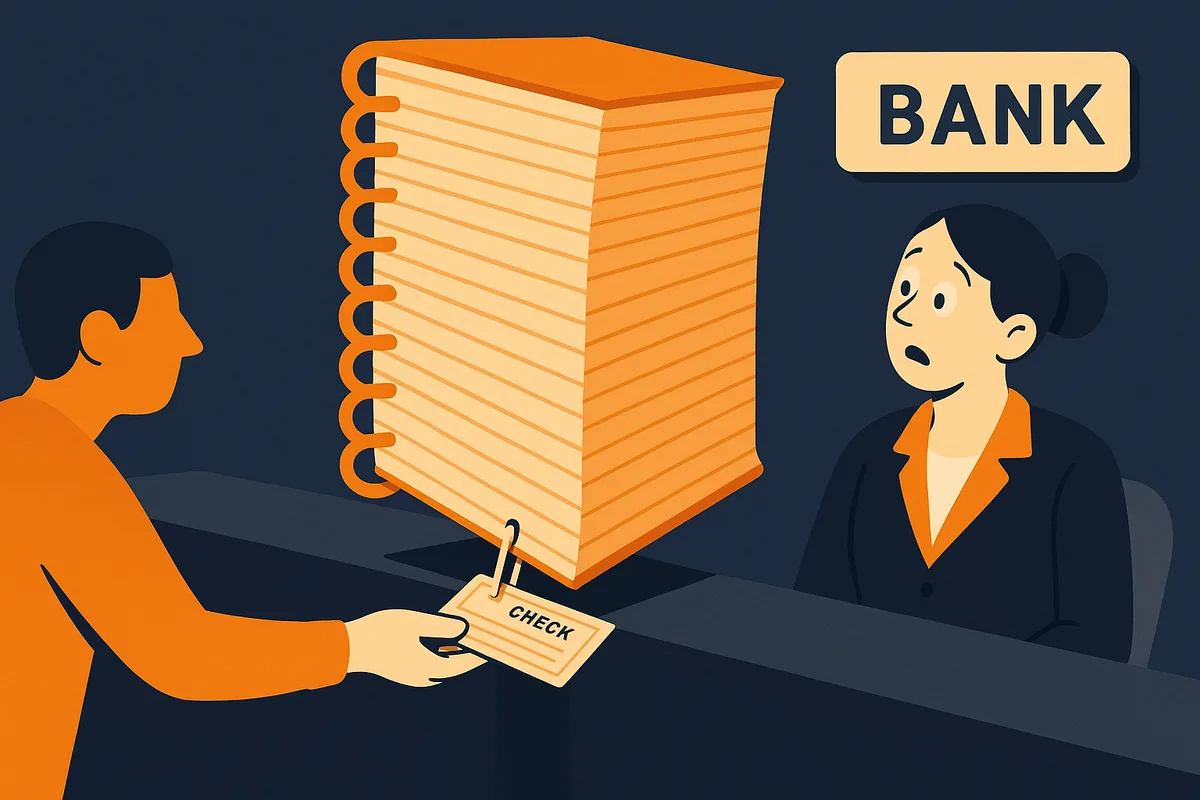
Bitcoin Core version 30 raised that default cap from 83 bytes to 100,000 bytes — and started allowing multiple memos per transaction. One hundred thousand characters is not a bigger memo line. It's roughly 1,200 old memo lines at once — about forty printed pages of dense text. In check terms: you're no longer scribbling in the corner. You're stapling an entire notebook to the check and sliding it across the counter.
Hold on — can they just do that?
Here's the part almost every headline got wrong, and the most important idea in this article. Bitcoin has two completely different kinds of rules, and this change only touched one of them.
What makes a check valid
The signature is real, the money exists, the amounts add up. In bitcoin these are the consensus rules — break them and every node on Earth rejects your transaction, memo or no memo.
What a teller will pass along
Each bank branch also has counter policies: "we don't accept checks with notebooks stapled to them." In bitcoin this is relay policy — each node's personal standard for which valid transactions it will pass to its neighbors.
So no committee rewrote bitcoin's rules — nobody can, that's rather the point. What happened is that the most popular node software changed its default counter policy. And because it's just a policy, any node operator can keep the old one: one setting restores the 83-byte limit, and alternative software like Bitcoin Knots ships with the strict filters still on. Plenty of people do exactly that.
Why would anyone want this?
It sounds absurd — why would the developers invite notebooks? Their argument is worth understanding even if you end up disagreeing with it, and it rests on one uncomfortable fact: the data was already coming in, through worse doors.
For years, people determined to stuff data into bitcoin have bypassed the tiny memo line entirely. Instead they disguised their data as fake payment information — phony recipients, sham signature fields — anywhere bytes could be smuggled. In check terms: if the teller won't take your notebook, you tear out the pages and forge them into the parts of the check the bank is required to process and file. The 2023–24 "inscriptions" craze moved megabytes this way daily.
Where did those side doors come from? Two earlier upgrades, oddly enough. SegWit (2017) added a separate compartment to transactions for signature data and, to encourage adoption, charged its bytes a quarter of the normal fee. Taproot (2021) then removed the practical size limits inside that compartment. Both were built to make payments cheaper and more private — but together they accidentally left a discount loading dock open around the back of the bank, and inscriptions drive right through it. Whether that counts as a bug is itself part of the war: strict-filter advocates (the Knots camp) literally track inscriptions as an exploited vulnerability that should be patched, while Core developers say it's an unavoidable side effect of intended design — you can't stop someone from encoding data in fields that must be allowed to hold arbitrary-looking bytes, like signatures.
That smuggling has a real cost. Some of it lands in the network's master ledger of who-owns-what — the one every node must keep in fast memory forever and can never clean out. A memo, by contrast, is the one field everyone can safely skip, compress, and archive, precisely because it's openly labeled "just a note." The developers' case, in a sentence: since we can't stop the notebooks, we'd rather they be stapled openly to the front of the check than forged into the bank's own books. A related worry sealed the argument: big data-stuffers had started couriering their transactions to miners through private side channels, bypassing the public network — and a bitcoin where reaching miners requires private connections is a more centralized bitcoin.
Why a lot of people are furious anyway
The counterargument is just as easy to state: bitcoin is a monetary network, not a filing cabinet.
- Everyone stores it forever, and storage isn't free. Once a notebook is confirmed into a block, it's part of bitcoin's permanent record — there is no deleting it, ever. Every archival node on Earth carries a copy for as long as bitcoin exists, and every brand-new node must download the entire history to join. More notebooks means more disk, more bandwidth, and a longer, costlier setup for each volunteer who wants to run a node — and if running a node gets expensive enough that fewer people do it, bitcoin itself gets more centralized. You'll hear "nodes can just prune old data" offered as a comfort here; treat it skeptically. A pruned node verifies everything but keeps almost nothing — so it can't feed the wallet servers most self-custody setups plug into, can't rescan an older wallet without re-downloading the entire chain, and can't help a new node join the network. If you run a node for sovereignty — to hold and spend your own coins against your own copy of the record — you generally need the full history, notebooks and all.
- Defaults are powerful. Critics argue the old limit, however leaky, expressed a community standard: this network is for money. Removing it, they say, is a welcome mat for data businesses that will crowd out payments.
- "They were coming in anyway" cuts both ways. If filters don't work, why did the polite 83-byte etiquette hold for a decade? Some see the change less as pragmatism and more as surrender.
The dispute got heated enough that node operators began switching software to make the point — Bitcoin Knots, which keeps the strict filters, grew from a rounding error to a meaningful slice of the network during 2025. Whatever you think of the outcome, the episode showed the system working as designed: nobody could force a rule change, so the argument played out as ten thousand independent operators voting with their settings.
Doesn't this fill up bitcoin with junk?
Here's the practical brake most coverage skipped: the memo isn't free. Every byte of note pays the same transaction fee as a byte of payment, and blocks are exactly the same size as before — the change didn't add one byte of capacity. A maxed-out 100,000-byte memo is a tenth of an entire block; whoever sends it pays for all of that space at market rate, outbidding everyone else who wanted it. Writing a notebook into bitcoin was always possible and always expensive. It still is — it's just honest about it now.
There is an awkward footnote, though, and critics are right to bring it up: because of SegWit's discount, a byte smuggled through the back-door compartment still costs a quarter of a byte written on the honest memo line. For truly large files, the loading dock remains the cheap route. The change invites small notes through the front door — it doesn't out-price the smugglers, and it wasn't designed to.
How we got here
- March 2014 The memo line is born Bitcoin Core 0.9 adds OP_RETURN as an official place for small notes — created, ironically, to discourage people from forging data into the payment fields. First cap: 40 bytes.
- 2015 Room for one sentence The default doubles to 80 bytes of note (83 with packaging) and stays there for a decade.
- 2017 & 2021 Two upgrades quietly open a loading dock SegWit gives a separate compartment of each transaction a 75% fee discount; Taproot later removes the practical size limits inside it. Both were designed for cheaper, more private payments — and together they accidentally make bulk data smuggling cheap. Bug or side effect? That argument is still going.
- 2023 – 2024 The side doors blow open The "inscriptions" boom smuggles images and tokens into bitcoin through the payment fields, bypassing the memo line and its limit entirely. Fees spike; the filter debate reignites.
- May – June 2025 The great argument A proposal to lift the cap triggers months of fierce public debate among developers and node operators — mailing lists, podcasts, and no small amount of shouting.
- October 10, 2025 Core 30 ships The default becomes 100,000 bytes, multiple memos allowed. Operators who disagree keep the old limit via a setting, or run software like Knots that filters by default.
What this means for you
- Your bitcoin is exactly as safe as before. Ownership, amounts, signatures — the rules that protect your money didn't change and can't be changed this way.
- Your transactions work the same and cost the same. Blocks didn't get bigger; a normal payment today looks identical to one from 2024.
- If you run a node, you have a choice to make — and it's genuinely yours. Keep Core 30's defaults, set
-datacarriersize=83to keep the old counter policy, or run Knots. Come to a meetup if you want help thinking it through. - Expect more notes on the ledger. Some will be timestamps and bridges to other systems; some will be junk. The fee market, not a filter, now decides how much.
The takeaway: Bitcoin didn't change what makes money move — it changed how big a note the average teller will accept alongside it. The memo line became a notebook, the notebook pays rent for the space it takes, and every node operator still gets to decide what crosses their own counter. That last part — no one in charge, defaults debated in the open, dissenters free to run their own policy — is the most bitcoin thing about the whole story.
Primary sources
- Bitcoin Core 30.0 release notes (the official change: default 83 → 100,000 bytes, multiple outputs allowed)
- The pull request that made the change (the developers' full reasoning, and the objections)
- CoinDesk — coverage of the June 2025 decision
- Unchained — Bitcoin Core v30 releases with expanded OP_RETURN capacity (a balanced overview of both camps)